Quick answer
- Best RTK mower: Segway Navimow i2 AWD (opens in a new tab). Precise, easy, great app.
- Best fusion (works almost anywhere): Mammotion LUBA 3 AWD (opens in a new tab).
- Best LiDAR, no antenna: Ecovacs GOAT O1000 LiDAR PRO (opens in a new tab).
- Simplest setup: Worx Landroid Vision (opens in a new tab) (camera only).
The three kinds of wire-free mower
| Type | How it knows where it is | Great at | Weak spot |
|---|---|---|---|
| RTK | Satellites, corrected by a base station or network to ~2 cm | Open lawns, straight neat lines | Dense trees, tall walls |
| LiDAR | Laser scans the surroundings and builds a 3D map | Shady, enclosed yards; no antenna | Very open lawns with few landmarks |
| Vision (camera) | AI recognises grass vs not-grass | Zero setup | Less precise, no real map |
| Fusion | Two or three of the above combined | Almost any yard | Price |
We go deeper in RTK vs LiDAR robot mowers.
Best wire-free robot lawn mowers
Segway Navimow i2 AWD (i206 / i210)
Best RTK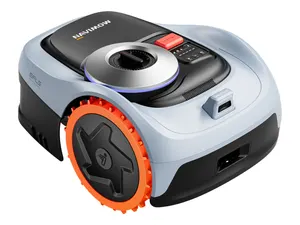 (opens in a new tab)
- Navigation
- Network RTK + vision
- Lawn size
- 0.15–0.25 acre
- Slopes
- up to 45% (24°)
Network RTK means you don't even need to put up an antenna: the mower gets its correction data over the internet. A camera helps it spot obstacles and get through weak-signal patches. For an open suburban yard it is precise, tidy and easy.
Launch price: from about $999 (maker list price, November 2026; Amazon is often lower)
Pros
- No antenna to install
- Neat striped mowing
- AWD
Cons
- Needs decent connectivity across the yard
Mammotion LUBA 3 AWD
Best fusion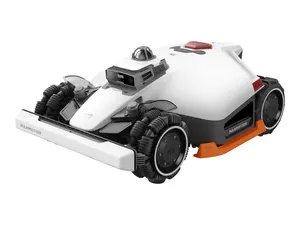 (opens in a new tab)
- Navigation
- LiDAR + RTK + vision ("Tri-Fusion")
- Lawn size
- 1,500–5,000 m² (0.37–1.2 acres) by version
- Slopes
- built for steep, rough lawns
LiDAR, RTK and cameras together. When the sky is blocked, LiDAR takes over; when the yard is wide open, RTK keeps lines straight. The most capable navigation you can buy for a home lawn.
Launch price: from about $2,399 (maker list price, November 2026; Amazon is often lower)
Pros
- Handles trees, walls and open lawns
- Huge traction
Cons
- Costly and heavy
Ecovacs GOAT O1000 LiDAR PRO
Best LiDAR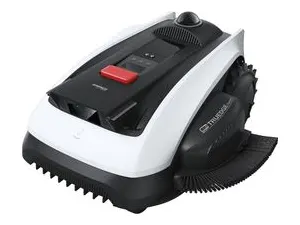 (opens in a new tab)
- Navigation
- LiDAR (no RTK antenna)
- Lawn size
- up to about 1,000 m² (0.25 acre)
- Slopes
- moderate
No antenna, no satellites, no wire. The GOAT maps your yard by laser, so it is ideal for gardens with lots of trees or close fences.
Launch price: about $999–$1,499 (maker list price, November 2026; Amazon is often lower)
Pros
- Works in shade
- Simple install
Cons
- Smaller lawns only
Dreame A3 AWD Pro
Strong edges- Navigation
- 3D LiDAR + vision
- Lawn size
- up to about 0.6 acre by version
- Slopes
- AWD for slopes
Dreame brought its robot-vacuum LiDAR know-how to the lawn. The A3 AWD Pro maps in 3D and is designed to cut closer to edges than many rivals.
Launch price: from about $1,799 (maker list price, November 2026; Amazon is often lower)
Pros
- 3D LiDAR mapping
- Good edge cutting
Cons
- Newer brand in mowers, shorter track record
Worx Landroid Vision Cloud
Easiest- Navigation
- AI camera (no wire, no RTK)
- Lawn size
- 0.25 acre (4WD versions up to 1 acre)
- Slopes
- up to 35–45% by model
Camera-only and no map: unbox, charge and mow. Good for simple, clearly edged lawns where precision matters less than convenience.
Launch price: about $1,000–$1,300 (maker list price, November 2026; Amazon is often lower)
Pros
- Almost no setup
Cons
- Less methodical mowing
Check your yard before you buy. Stand in each corner of the lawn. If you can see a lot of open sky everywhere, RTK will be great. If big trees or a tall house block most of the sky in some spots, choose LiDAR or fusion.
Lots of shade? Read the best robot mowers for yards with trees, our Dreame A3 review, and Ecovacs GOAT vs Navimow.
Our verdict
Pick the Navimow i2 AWD for open yards, the GOAT O1000 for shady ones, and the LUBA 3 when you have a bit of everything plus slopes. Camera-only models like the Landroid Vision are a fine choice when you just want it to work with no setup at all.
Check price on Amazon (opens in a new tab)Frequently asked questions
How do robot mowers work without a wire?
They know their position using satellites corrected to centimetre accuracy (RTK), a spinning laser scanner (LiDAR), cameras, or a mix. You draw the boundary once in an app, usually by driving the mower around the edge. Our guide to how robot lawn mowers work explains each method.
Do wire-free robot mowers work under trees?
RTK-only models can lose accuracy under dense canopy or right next to tall buildings. LiDAR models and fusion models (LiDAR + RTK + camera) handle these spots much better.
Are wire-free mowers less reliable than wired ones?
Wired mowers are simpler and very dependable once installed. Wire-free mowers are now reliable in most yards, but in difficult spots they can occasionally need help. Fusion navigation has closed most of the gap.